LOGIN
LOGIN

Artificial Intelligence in Elevator Technology: Smarter, Safer Vertical Transit
Elevators move billions of people every day, yet for decades their core control logic relied on rigid rule sets and fixed maintenance schedules. Today, Artificial Intelligence (AI) paired with Internet of Things (IoT) sensors is shifting vertical transportation from reactive repair and basic dispatch toward continuous learning, early fault detection, and dynamic traffic flow.
How AI Transforms Modern Elevator Systems
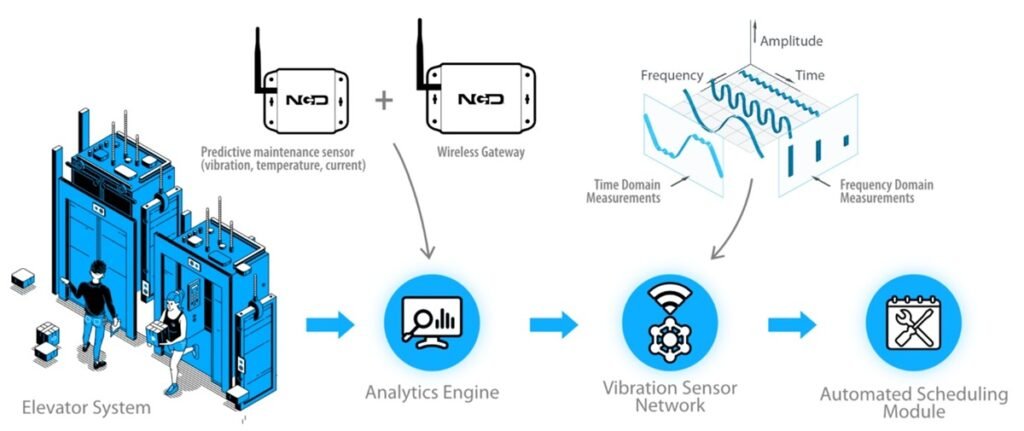
Traditional servicing follows calendar intervals or responds after a car stops. AI models ingest continuous telemetry – door open/close durations, motor current draw, cabin vibration, guide-rail alignment, and machine-room temperature – to spot subtle drift days or weeks before failure. Door mechanisms account for a large share of service calls, so catching rising friction or cycle variance early prevents sudden stoppages and passenger entrapments. Major manufacturers such as Mitsubishi, Otis, KONE, Schindler, and TK Elevator run connected cloud platforms (Optional) that analyze equipment signals and guide technicians to the probable root cause before they arrive on site.
In high-rise offices, hospitals, and mixed-use towers, passenger patterns shift throughout the day – morning arrivals, lunch rushes, and evening departures. Machine learning algorithms recognize recurring demand curves and optimize car allocation:
Elevators draw significant power during acceleration and can sit idle for hours overnight. AI-driven controllers reduce empty mileage, put idle drives or lighting and ventilation into low-power states, and coordinate with building management systems. During emergencies such as fires or security events, integrated systems can prioritize evacuation routes or restrict floor access automatically.
On the manufacturing and modernization side, engineers use digital twin to test control algorithms, tune ride comfort, and evaluate wear across building profiles before deploying changes in the field.
Traditional vs. AI-Enabled Elevators
| Dimension | Conventional Elevators | AI Enabled Elevators |
|---|---|---|
| Maintenance | Fixed monthly/quarterly visits or reactive call-outs after faults. | Continuous sensor monitoring with early anomaly alerts. |
| Dispatching | Basic up/down hall calls with fixed logic. | Pattern-aware grouping and destination-based routing. |
| Diagnostics | On-site troubleshooting from error codes or inspection. | Remote telemetry with pre-dispatch fault insights. |
Practical Limits and Challenges
AI is not a cure-all for worn or poorly built hardware. Cost, compatible hardware, suitable Internet availability, and noisy signals from aging machinery can limit accuracy unless paired with clean sensors and sound mechanical fundamentals. Retrofitting older buildings involves upfront sensor and connectivity costs, while service teams need training to interpret analytics alongside hands-on mechanical skills. Cybersecurity, data privacy, and fail-safe mechanical brakes remain essential guardrails as elevators become more connected.
Stay tuned for the next article on similar topic………..


